
Independent reviews — we don’t sell software, and we list every tool’s weaknesses, not just its strengths.
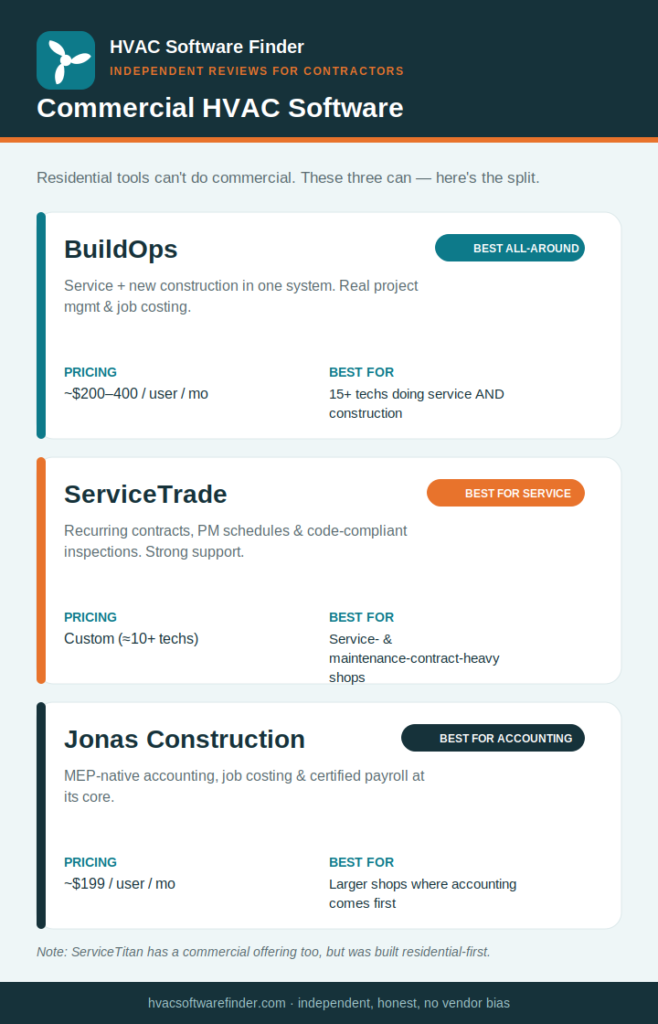
Quick answer: The residential field service tools that dominate “best HVAC software” lists — Jobber, Housecall Pro, even ServiceTitan — were built for break-fix service work, not commercial mechanical contracting. If you do AIA progress billing, prevailing wage, multi-phase projects, or large preventive-maintenance contracts on commercial buildings, you need a platform built for that. The three worth your time: BuildOps (best all-around for commercial service plus new construction), ServiceTrade (best for service- and maintenance-contract-heavy shops), and Jonas Construction (best when accounting and job costing are the priority). Here’s how they actually differ.
Why commercial HVAC is a different software problem
Almost every “best HVAC software” guide quietly assumes you’re a residential service shop — replacing furnaces and AC units in houses, billing the homeowner on the spot. Commercial mechanical work is a fundamentally different business, and the popular tools weren’t designed for it. If you maintain rooftop units across a portfolio of buildings, bid multi-phase mechanical projects, bill general contractors through AIA pay applications, or run crews under prevailing-wage rules, the residential platforms will fight you at every turn.
We’re independent — we don’t sell software, so we have no reason to stretch a residential tool to fit a job it can’t do. The honest truth, which we also state on our main HVAC software guide: none of the big three residential platforms adequately serve commercial mechanical work. Commercial contractors need a different category of tool entirely. Here’s what that category has to handle that residential software doesn’t:
- Project-based work alongside service. Commercial shops mix recurring service and maintenance contracts with large, multi-phase installation projects — and need both in one system.
- Progress and AIA billing. Billing a GC isn’t a one-tap invoice; it’s pay applications, schedules of values, and retention.
- Job costing that’s real, not bolted on. Tracking labor, material, and equipment cost against a project budget is the difference between a profitable job and a guess.
- Preventive-maintenance contract management. Recurring PM schedules across hundreds or thousands of assets in multiple buildings, with the asset history to back it up.
- Asset and equipment tracking at scale. Commercial clients expect a full service history on every rooftop unit and chiller you touch.
- Prevailing wage and certified payroll for public and union work.
How we evaluate
For commercial platforms we weighted the things that actually separate them: depth of project management and job costing, AIA/progress billing support, preventive-maintenance and service-contract management, asset tracking across building portfolios, accounting and QuickBooks (or ERP) integration, realistic total cost including implementation, and what verified commercial contractors report on G2, Capterra, and trade forums. Note that this is the one corner of our site aimed above the 15-tech mark — commercial mechanical contracting is simply a larger-shop business, and we’ve evaluated these tools accordingly.
The top commercial HVAC platforms, explained
1. BuildOps — best all-around for commercial service + construction
BuildOps is purpose-built for commercial mechanical contractors, and it’s the platform we’d point most commercial HVAC shops to first. Its core strength is handling both sides of a commercial business in one system: recurring service and maintenance contracts and project-based new construction. The project module is real — daily reports, RFIs, submittals, and job costing — not a residential service app with a “projects” tab bolted on. It includes purpose-built equipment and asset tracking for commercial fleets, customer hierarchies that organize assets across multiple properties under one client, a strong mobile app with features like nameplate scanning, and it integrates with QuickBooks Online as well as ERP tools like Sage and Vista.
Pricing is custom-quoted and not public, but independent estimates put it around $200–400 per user per month, and it’s clearly aimed at established shops — most reviewers cite 15+ techs and project-based revenue. Implementation is a genuine project, not a weekend.
Where it falls short: overkill (and overpriced) for residential-only HVAC — if that’s you, Jobber, Housecall Pro, or a residential specialist is a far better fit. No public pricing makes budgeting harder, implementation is long, and contractors note customer support quality can be inconsistent.
Best for: Commercial-only or commercial-heavy HVAC contractors (roughly 15+ techs) doing both service and new construction.
2. ServiceTrade — best for service- and maintenance-contract-heavy shops
ServiceTrade is an end-to-end platform built specifically for commercial HVAC, mechanical, and fire-protection service contractors — and if your business is weighted toward recurring service and maintenance contracts rather than ground-up construction, it’s often the better fit than BuildOps. It’s strongest where commercial service lives: scheduling and dispatch, recurring PM contracts, code-compliant inspections with report generation, asset and service history, a customer portal that builds trust with commercial clients, and a “sales success” CRM module for landing and renewing service agreements. It integrates with QuickBooks and emphasizes the transparent reporting that commercial clients increasingly demand. Over 1,300 commercial contractors use it, and user-satisfaction scores run high.
Pricing is custom-quoted (an enterprise tier covers recurring contract invoicing, analytics, and AI dispatch features), so you’ll need a demo to get real numbers.
Where it falls short: it’s more service- than construction-oriented — its project and job-costing depth doesn’t match BuildOps or Jonas for shops doing heavy new construction. It can be more complex and pricier than a small residential shop needs, and contractors report that getting full value requires real upfront training investment.
Best for: Commercial HVAC and mechanical contractors whose business is built on service agreements and recurring preventive maintenance. Read our full ServiceTrade review.
3. Jonas Construction — best when accounting and job costing come first
Jonas Construction Software is one of the few platforms genuinely designed for MEP trades — mechanical, electrical, plumbing, fire protection, HVAC — with accounting at its core rather than bolted on. Its job costing, payroll (including the certified-payroll and prevailing-wage handling that public work demands), and service-contract modules reflect real mechanical-contractor workflows, not general-contractor workflows forced onto a subcontractor. For an established commercial shop that wants its accounting, project management, and service management in one integrated suite, that depth has real value. It’s been serving the construction trades for decades and offers both cloud and on-premise options.
Independent pricing references put it around $199 per user per month on annual terms, before the modules and implementation that a full deployment requires.
Where it falls short: Jonas prices and scopes for the larger contractor — think $10M+ shops with a full accounting team and the IT bandwidth for a multi-month implementation. Reviewers note that its breadth sometimes comes at the expense of depth in specialized areas, the interface feels dated, costs escalate as you add modules and seats, and the learning curve is steep. Smaller commercial shops often find it heavier than they need.
Best for: Larger, established commercial mechanical contractors where integrated accounting and job costing are the top priority.
What about ServiceTitan for commercial?
ServiceTitan has a commercial offering and serious operational depth, and very large mechanical operations do run it. But it was originally built for residential service, and for dedicated commercial-construction workflows — AIA billing, multi-phase project management, job costing — the purpose-built tools above generally fit better. If you’re a large operation already weighing ServiceTitan, it belongs on your shortlist; just don’t assume the residential powerhouse is automatically the right commercial tool. See our full ServiceTitan review for where it does and doesn’t earn its cost.
A reality check on cost
Every platform here is custom-quoted and priced for established operations — expect per-user costs in the low hundreds per month plus a real implementation project. That’s the nature of commercial mechanical software, and it’s why we don’t recommend forcing a commercial tool onto a small residential shop (or vice versa). If you’re actually a small residential contractor who landed here, our guide to the best HVAC software for small businesses points you to tools priced and built for you.
How to choose in 60 seconds
- Commercial service + new construction in one system → BuildOps.
- Service- and maintenance-contract-heavy, inspection-driven → ServiceTrade.
- Accounting, job costing, and certified payroll are the priority → Jonas Construction.
- Very large operation already considering it → ServiceTitan, eyes open.
Frequently asked questions
What’s the best software for commercial HVAC contractors?
For most commercial mechanical shops, BuildOps is the strongest all-around choice because it handles both commercial service and project-based construction. ServiceTrade is better if your business is built on service and maintenance contracts; Jonas Construction is better if integrated accounting and job costing are your priority.
Can I use Jobber or Housecall Pro for commercial HVAC?
For light commercial service work, possibly — but they’re residential service tools at heart. They don’t handle AIA/progress billing, multi-phase project management, or job costing, so true commercial mechanical contractors will outgrow them quickly.
Does commercial HVAC software integrate with QuickBooks?
Yes — BuildOps and ServiceTrade both integrate with QuickBooks, and BuildOps also connects to ERP systems like Sage and Vista. Jonas has accounting built in. If QuickBooks compatibility is your main concern, see our dedicated HVAC software and QuickBooks guide.
How much does commercial HVAC software cost?
Most commercial platforms are custom-quoted rather than priced publicly. Independent references put BuildOps around $200–400 per user per month and Jonas around $199 per user per month on annual terms, with implementation fees on top. Always get a written quote for your specific shop size and module needs.
What’s the difference between commercial and residential HVAC software?
Residential tools optimize for fast break-fix service and on-the-spot homeowner billing. Commercial tools add project management, AIA/progress billing, job costing, certified payroll, and asset tracking across building portfolios — the things commercial mechanical contracting requires and residential software lacks.
This guide is independent and reader-supported. Some links to software are affiliate links, meaning we may earn a commission at no extra cost to you if you sign up — this never affects our recommendations or the cons we list. Pricing and features change often, and most commercial platforms quote custom pricing; verify current details with each provider before purchasing. Last reviewed: 2026.